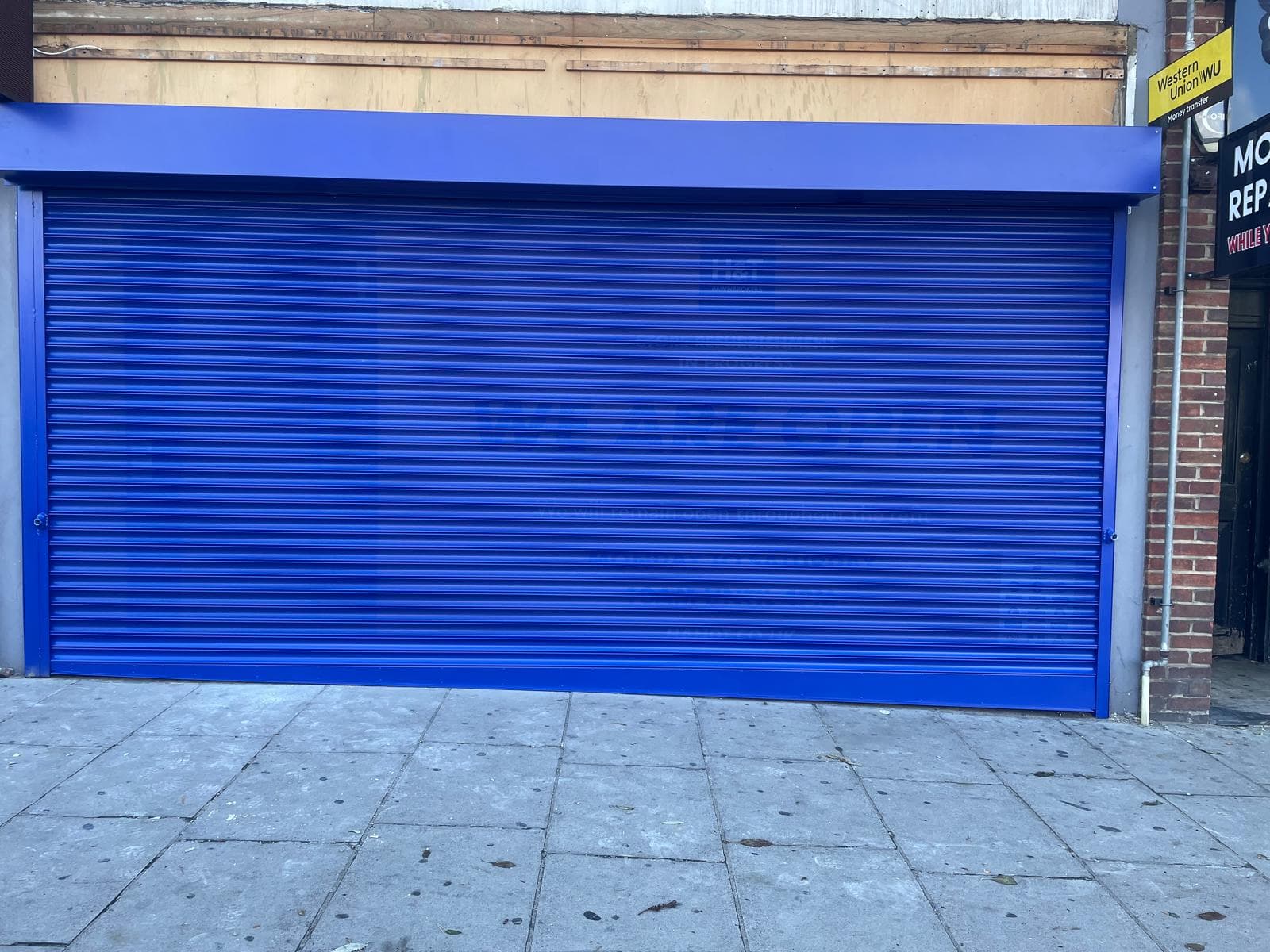
Roller Shutters
Commercial roller shutters for retail, industrial, and warehouse premises. Manual, electric, and fire-rated options with LPS 1175 security-rated curtains available.
Roller shutters are one of the most practical and cost-effective security solutions available to commercial and industrial property owners. When correctly specified for the application, a roller shutter provides reliable overnight security, weather protection, and where required, fire containment — all within a compact, retractable assembly that does not impede the operation of the premises during trading hours.
Sigma Shop Fronts designs, supplies, and installs roller shutters across a wide range of commercial applications, from small retail units requiring a face-fit manual curtain to large industrial loading bays needing a high-speed, motor-driven door with full automation and safety edge protection.
Curtain Construction and Security Ratings
Roller shutter curtains are available in perforated, solid, and vision-strip configurations. Perforated laths allow some visibility and airflow when the shutter is closed and can reduce the visual impact of a shuttered frontage. Solid lath curtains provide maximum weather exclusion and privacy.
For security-critical applications, we specify curtains tested to LPS 1175 (Loss Prevention Standard 1175), the industry benchmark for physical attack resistance. LPS 1175 is graded from A (basic deterrence) through to H (resistance to prolonged attack with specialist tools), and the appropriate grade is selected in consultation with the client's insurer and in accordance with the risk profile of the premises. Many commercial insurers now require a minimum of LPS 1175 SR1 or SR2 for unattended retail premises.
Curtain laths are roll-formed from galvanised mild steel or aluminium alloy. Aluminium is specified where weight, corrosion resistance, or annual maintenance burden is a primary concern; steel is typically preferred where higher security ratings or impact resistance is paramount.
Operating Systems
Manual shutters are operated via a spring-balanced mechanism — the spring stores energy as the shutter closes and releases it to assist opening. Manual operation is appropriate for smaller openings up to approximately 3.5 m in width and where operating frequency is modest.
Electric shutters use a tubular or side-mounted motor connected to a gear reducer and drive shaft. They are operated by a key switch, push-button panel, or remote control, and can be integrated with a building management system or external timer for automated opening and closing. All our electric shutter installations include a manual override mechanism to allow operation during a power failure.
Safety edges, photocells, and pressure-sensitive bottom rails are fitted as standard on all motorised installations, in line with the Machinery Directive (now retained in UK law as the Supply of Machinery (Safety) Regulations 2008) and the guidance issued by the Door and Hardware Federation (DHF).
Fire-Rated Roller Shutters
Fire-rated roller shutters provide compartmentalisation in commercial and industrial premises, containing the spread of fire between zones in accordance with the passive fire protection strategy for the building. Our fire shutters are designed and tested in accordance with BS EN 1634-1 (fire resistance and smoke control tests for door and shutter assemblies) and carry the appropriate fire performance classification — typically EI 60 or EI 90, denoting integrity and insulation for 60 or 90 minutes respectively.
Fire shutters are controlled by a fusible link or, in more sophisticated installations, by a signal from the building's fire detection and alarm system. Gravity-fail-safe release is standard, ensuring the shutter closes automatically on detection of a fire even if power is lost.
Installation of fire shutters must be completed and certified by a company with appropriate third-party accreditation. Sigma Shop Fronts holds the relevant certification and provides a fire shutter completion certificate that forms part of the building's fire safety record.
Structural Considerations
Roller shutters impose both dead loads (the weight of the curtain and housing box) and dynamic loads (wind, impact, and operation forces) on the surrounding structure. Before installation, we assess the condition and load-bearing capacity of the lintel or structural member above the opening. Where the existing structure is inadequate, we work with a structural engineer to design a suitable bearing arrangement.
All shutters are installed with a weather seal along both side guides and at the bottom rail, preventing draught and water ingress when closed. For installations in exposed coastal locations, we specify enhanced corrosion protection, including marine-grade aluminium sections and stainless-steel fixings.
Roller Shutters — Frequently Asked Questions
Installation of a roller shutter as a replacement for an existing shutter typically falls under permitted development. However, fire-rated shutters installed as part of a passive fire strategy require a Building Regulations application, and a completion certificate issued by a building control body. New openings created in an external wall will also trigger a Building Regulations submission. We manage this process on behalf of clients where required.
The DHF (Door and Hardware Federation) recommends that all power-operated doors, including roller shutters, are inspected and serviced at least annually by a competent person. For high-cycle applications — such as a loading bay operating 20 or more cycles per day — we recommend six-monthly servicing. Annual servicing should include inspection and lubrication of all moving parts, testing of safety edges and photocells, and verification that all emergency release mechanisms function correctly.
All Sigma Shop Fronts electric shutter installations include a manual override facility — typically a removable hand chain or crank handle — that allows the shutter to be raised or lowered without electrical power. For fire shutters, a gravity-fail-safe mechanism ensures the shutter closes automatically under its own weight in the event of power failure or fire detection signal, regardless of whether the motor is operational.
Yes. In many cases a roller shutter can be retrofitted into an existing aluminium or steel shopfront by installing a face-fit box housing above the aperture and side guides within the existing frame reveals. We assess feasibility at the survey stage, taking into account the available headroom, reveal depth, and structural condition of the existing frame. Where a face-fit installation is not practical, a built-in system with concealed housing box can be specified as part of a new shopfront installation.
Ready to Get Started?
Tell us about your roller shutters project and we will arrange a free site survey at a time that suits you.
- Free no-obligation survey
- Written quotation within 48 hours
- Nationwide installation teams